Fracture geometry
Fracture sandbox
Break a solid into seeded fragments at an impact point, inspect the interior faces, and reassemble it.
Try it
All editing and processing stays in your browser.
Getting started
- Click the intact panel to place the impact, or use its horizontal and vertical controls.
- Generate cuts after changing fragment count or seed. Fracture panel plays the computed trajectory.
- Scrub time or reassemble to follow the exact motion backward.
- Pause and separate cuts to inspect each cell; export the visible fragments as OBJ.
Made with this tool
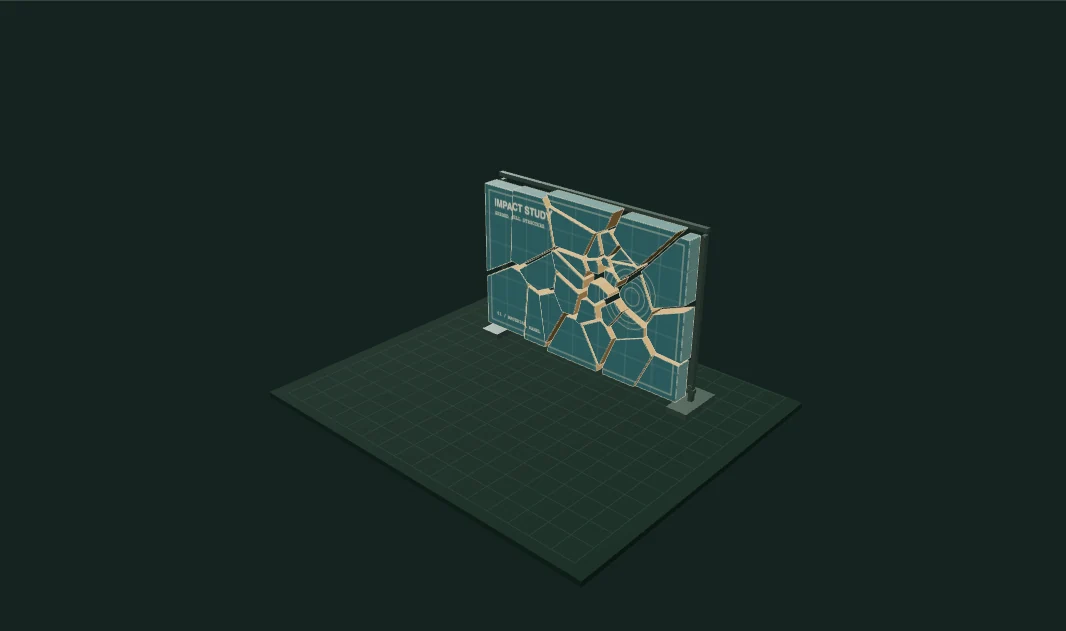
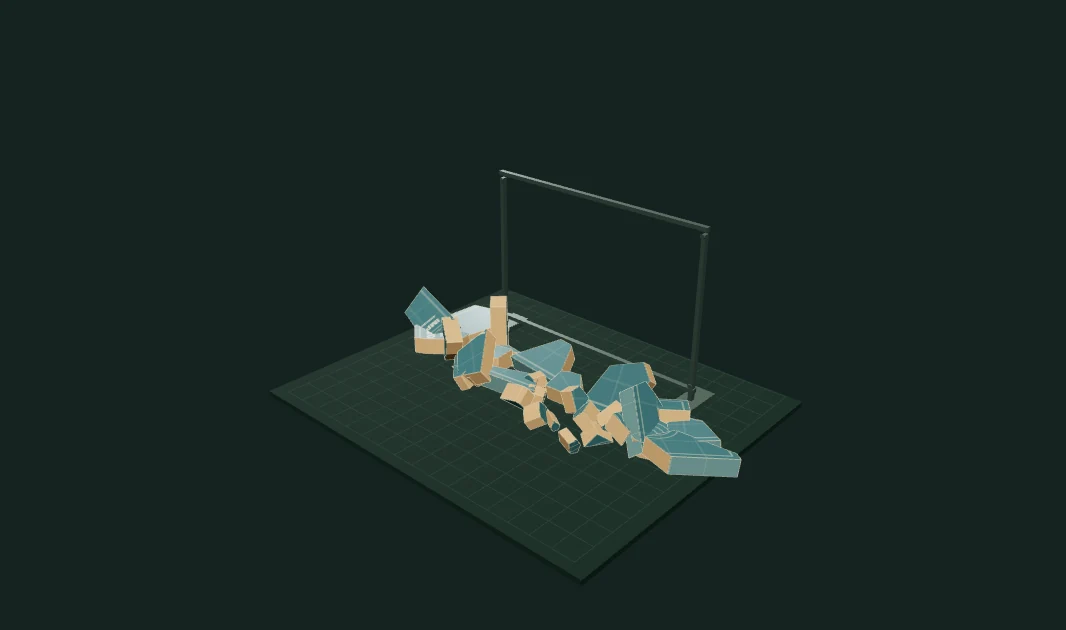
Examples captured from the running editor.
Implementation and limits
Choose an impact point, cut a solid panel into seeded Voronoi shards, and inspect the newly exposed interior faces through a reversible rigid-body flight.
- Voronoi cells are cut in 2D and extruded through a thin rectangular panel. This is not volumetric 3D fracture.
- Fragments have gravity, rotation and vertex-based floor contact, but do not collide with one another.
- Material presets change appearance. They do not model a material’s fracture toughness or crack propagation.