Multiresolution synthesis
Image Analogies
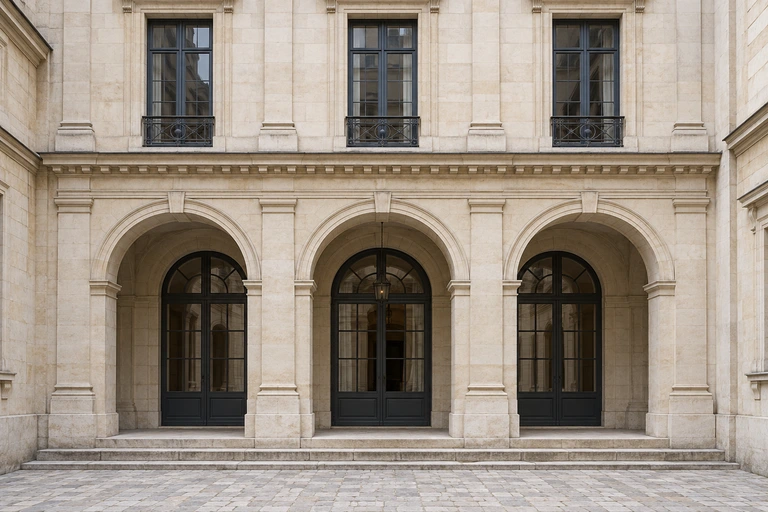
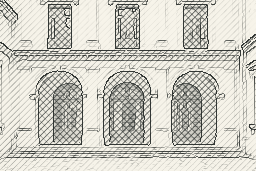
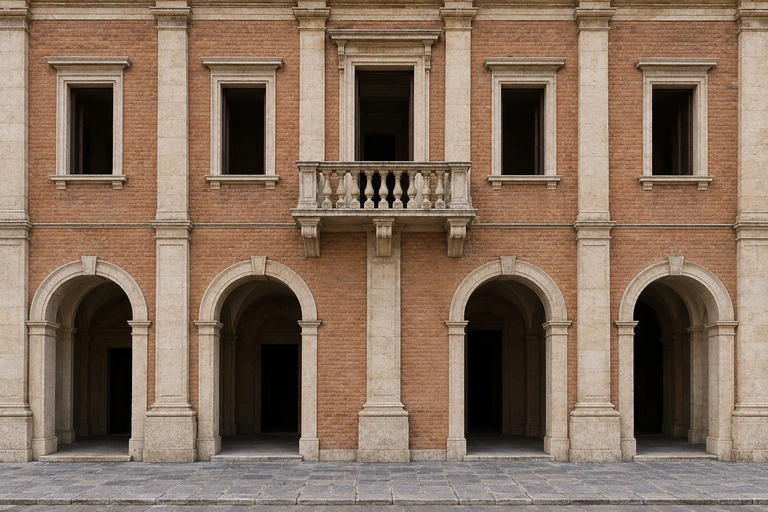
Provide a courtyard photograph and its aligned engraving treatment. Neighborhood matching transfers that relationship to a different architectural photograph.
Try it
Runs locally in your browser. Uploaded images stay on your device.
A and A′ must be an aligned pair. The sample A′ is a registered engraving of the courtyard; B is a separate arcade photograph.
Ready when you are.
Worker processing · local inputs · downloadable output
How it works
A and A′ must be an aligned pair. The sample A′ is a registered engraving of the courtyard; B is a separate arcade photograph.
- Build matched Gaussian pyramids for A, A′, and the new image B.
- Compare source appearance and already-synthesized neighborhoods to find candidate correspondences.
- Choose between appearance matches and coherent neighbor predictions, then copy pixels from A′ into B′.
Read the original research
Hertzmann, Jacobs, Oliver, Curless & Salesin · 2001
Computed examples
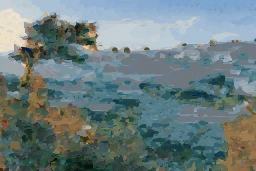
An aligned photo-to-engraving pair, a new architectural input, and the synthesized result.
Source photographs were generated for these studies. The displayed results were computed by the algorithms; they are not generated illustrations of an expected result. Sobel contours and tone-controlled hatching prepare A′ from A. That filter is never applied to B: B′ is synthesized by matching neighborhoods and copying pixels from A′. Published previews are compressed for the web.
Implementation and limits
A small, bounded multiresolution synthesis study with sampled search. It does not use a neural network or infer semantic style; patch artifacts are visible, especially across unrelated scenes.
Interactive settings are bounded to keep the experiment practical in a browser. Higher detail can cost more processing time without guaranteeing a better result. The implementation and its tests are available in the source repository.