Moving least squares
Moving least squares
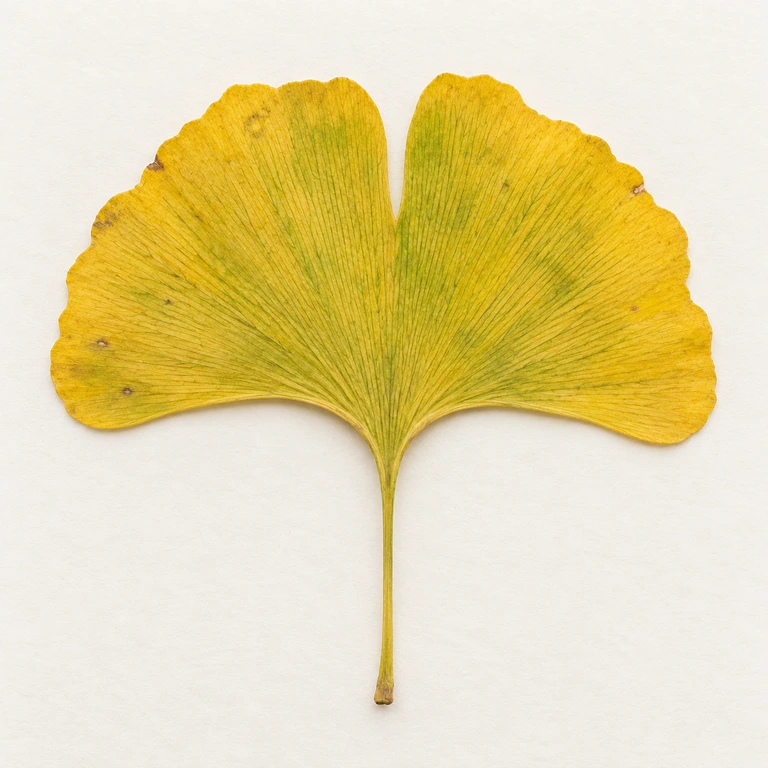
Anchor a ginkgo leaf’s stem and pull its fan-shaped blade. Local transformations bend the existing image around the points you control.
Try it
Runs locally in your browser. Uploaded images stay on your device.
Drag a pin to deform the image. Double-click to add one. The selected pin also has keyboard-accessible position controls.

Ready when you are.
Worker processing · local inputs · downloadable output
How it works
Drag a pin to deform the image. Double-click to add one. The selected pin also has keyboard-accessible position controls.
Control points anchor the stem and fan of the leaf. Moving one point changes a continuous field of local transformations, bending the existing pixels while the other pins hold their positions. No missing content is synthesized.
- Give nearby control points more influence than distant ones.
- Solve a weighted rigid, similarity, or affine transformation separately at each mesh vertex.
- Warp a triangle mesh forward and resample its pixels, keeping control points interpolated.
Read the original research
Schaefer, McPhail & Warren · 2006
Computed examples
Outputs from the same implementation used in the playground.
Source photographs were generated for these studies. The displayed results were computed by the algorithms; they are not generated illustrations of an expected result. Published previews are compressed for the web.
Implementation and limits
The continuous deformation is approximated by a triangulated image mesh. The fixed-border option anchors the image edge; free borders can reveal transparent regions. Extreme crossed pins can still fold the mesh.
Interactive settings are bounded to keep the experiment practical in a browser. Higher detail can cost more processing time without guaranteeing a better result. The implementation and its tests are available in the source repository.