Patch-based reconstruction
Texture transfer
Reconstructing the shape and tones of one image with the material of another. Every output pixel comes from the source texture.
Try it
Runs locally in your browser. Uploaded images are not sent anywhere.
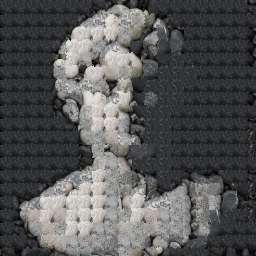
Example output. Choose settings, then run the study.
Every output pixel comes from the texture sample. The target only guides which patches are selected.
Material meets structure
A texture has its own local detail. A target image has an overall shape. The patch search has to satisfy both: match the neighboring material while choosing patches with the right light and dark structure.
Image quilting extends a material without a target subject. Here, the sculpture supplies the structure, while pebbles or woven fabric supply every output pixel. Image Analogies explores a different problem: learning a treatment from an aligned before-and-after pair.
- Build a guide. Smooth and normalize the luminance of the texture and target. Compare these guides when scoring a candidate patch.
- Balance the errors. Combine target correspondence with overlap error. The structure slider controls that tradeoff; the chosen patch keeps its original colors.
- Refine at a smaller scale. Reduce patch size by one third on each pass. Later passes also compare against the previous result, preserving its broad structure while resolving finer detail.
Computed examples
One sculpture, two source materials. Both reconstructions use the same target and settings.
The source photographs were generated for these experiments. The results were computed by the same algorithm used above: 256 × 256 output, 36px initial patches, 6px overlap, three passes, 75% target structure, up to 384 candidates, seed 42. Published previews are compressed; PNG exports preserve the computed pixels.
What this version does—and where it stops
The expensive search runs in a Web Worker, with progressive previews and cancellation. A bounded, seeded sample of candidate patches keeps it practical in a browser. Larger candidate sets explore more of the source, at a higher processing cost.
Flat target regions can keep selecting similar patches, creating repeated rows. Strong structure matching can also break the natural continuity of the texture. Neither higher resolution nor a larger search guarantees a more convincing result.
Opposite edges are not constrained to match, so the output is not guaranteed to tile periodically. This is a classical patch-based method, with no neural model.