Numerical fluid dynamics
Stable Fluids
Stir colored dye through a two-dimensional fluid. Diffusion, advection, and pressure projection evolve the field.
Try it
Runs locally in your browser. Uploaded images stay on your device.
Start the simulation, then drag across the canvas to inject dye and momentum. Pause to inspect a frame. Keyboard: focus the canvas and press arrows to stir.
Ready when you are.
Worker processing · local inputs · downloadable output
How it works
Start the simulation, then drag across the canvas to inject dye and momentum. Pause to inspect a frame. Keyboard: focus the canvas and press arrows to stir.
- Inject forces and dye, then diffuse them across the grid.
- Trace backward through the velocity field to advect quantities.
- Solve for pressure and subtract its gradient to reduce divergence.
Read the original research
Jos Stam · 1999
Computed examples
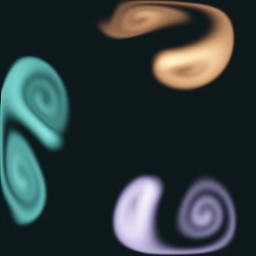
Identical emitters, seed 42, and 110 steps (1.83 simulated seconds). Only viscosity changes.
These images are actual snapshots of the simulation. They were rendered from the computed branch geometry or fluid fields; they are not generated concept images.
Implementation and limits
A bounded two-dimensional grid with closed walls and numerical dissipation. Stability does not mean perfect accuracy or conservation; this is not a three-dimensional water renderer.
Interactive settings are bounded to keep the experiment practical in a browser. Higher detail can cost more processing time without guaranteeing a better result. The implementation and its tests are available in the source repository.